In this article
A low severity weakness can be unimportant on its own yet become valuable as a stepping stone. Attack path analysis looks beyond isolated findings to understand how information, access, trust and privilege can combine into a larger compromise.
Attack Paths: How Small Security Weaknesses Become Serious Compromises
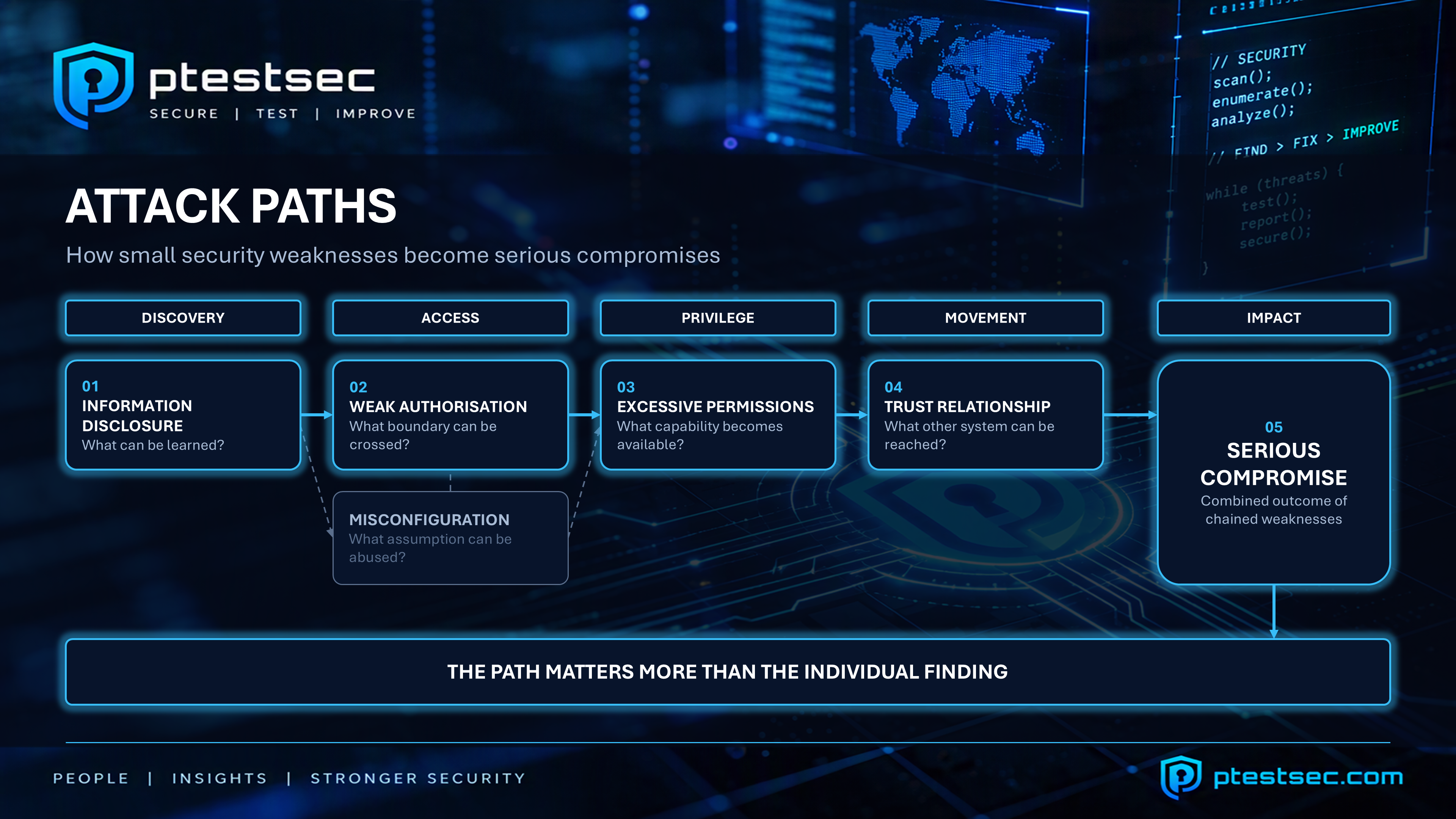
Security findings are naturally reported one at a time. Each weakness needs evidence, an owner, a severity and a remediation. That structure is necessary for fixing things, but it can encourage a misleading mental model: that attackers also experience the system one finding at a time. They do not. A small information disclosure can make a later attack more precise. A weak access control decision can turn that information into data exposure. An over permissioned service identity can turn the resulting foothold into access to a different system. The important security outcome can emerge from the relationship between weaknesses rather than from any one issue in isolation.
Attack path thinking asks a simple question after every observation: what new capability does this give an attacker, and what can that capability reach next?
Severity and Position Are Different Things
A finding's technical severity describes characteristics of that vulnerability. Its position within an architecture describes something else: how useful it is as part of a path. Consider an endpoint that reveals valid account identifiers. On its own, the impact may be limited. Now place it beside a password reset workflow that leaks whether an account has a particular recovery method, an API with inconsistent ownership checks and an administrative function that can be reached by users with a particular role. The identifier disclosure may become the first reliable step in navigating the rest of the system.
The lesson is not that every informational issue should suddenly be labelled critical. Inflating individual severities makes reports less useful. The better approach is to preserve the severity of each finding while separately explaining the demonstrated chain and the combined outcome.
Attack Paths Grow Through Capabilities
Thinking in terms of capabilities makes chains easier to reason about. A weakness can provide knowledge, identity, execution, network position, access to a resource or a change in privilege. That capability then becomes the starting point for the next step.
An unauthenticated information leak may produce usernames or internal object identifiers. A weak authentication control may turn that knowledge into an account. The account provides an authenticated position from which authorisation controls can be tested. An authorisation flaw may reveal an API token or cloud credential. That identity may have access to systems that were never reachable directly from the Internet.
At every stage, the attacker begins the next step with more knowledge or privilege than they had before. This is why assessing findings only from the original external starting position can underestimate what becomes possible later in the chain.
Trust Relationships Are Natural Bridges
Modern environments are full of legitimate trust: applications trust identity providers; APIs trust gateways; workloads trust service identities; internal systems trust network position; cloud roles trust selected principals. Security depends on those relationships being narrow and explicit.
Attack paths often form when one component assumes another has already performed a security check. An API gateway validates that a token is authentic, while the downstream service assumes the caller is authorised for the requested tenant. A web application sanitises one input but trusts a value returned by an internal service. A server accepts a connection from an internal address and therefore applies weaker controls.
None of those trust relationships is automatically wrong. The testing question is whether the trust matches the actual boundary. If compromising one low privilege component silently grants the assumptions of a more trusted component, the path may be much wider than the original weakness suggests.
Identity Is Often the Thread Through the Chain
Attack paths are frequently identity paths. The attacker moves from unauthenticated, to ordinary user, to service identity, to privileged role, even when no traditional memory corruption or remote code execution vulnerability appears anywhere in the sequence.
OWASP's authorisation guidance stresses least privilege, deny by default behaviour and permission checks on every request. Those principles matter precisely because authentication alone only establishes who the caller is. The system must still decide what that identity is allowed to do with each resource and action.
For a tester, the key is to model identities and relationships rather than merely endpoints. Which roles can call this function? Does the server validate ownership? Can a token issued for one audience be replayed elsewhere? Can one workload assume another role? Does an administrative action rely on the interface hiding a control rather than the server enforcing permission?
Business Logic Can Connect Otherwise Safe Components
A system can correctly validate its individual inputs and still expose a workflow that permits an unintended security outcome. Business logic determines the order, frequency and conditions under which valid operations are allowed. OWASP's business logic testing guidance includes workflow circumvention, integrity checks, timing and restrictions on function use. Those areas are fertile ground for attack paths because they can convert legitimate functionality into an unintended capability.
Suppose an application correctly validates an order identifier, quantity and user session. If it allows an approval step to be called before the server has established the required state, the weakness is not malformed input. It is a broken assumption about sequence. If the resulting state exposes a privileged endpoint or creates a reusable token, that business logic issue can become the bridge to a broader chain.
A Conceptual Example
Imagine a customer platform with four individually modest weaknesses. First, an unauthenticated endpoint reveals predictable customer identifiers. Second, an authenticated API accepts those identifiers without consistently verifying ownership. Third, a support feature exposes limited metadata about privileged accounts. Fourth, an internal administration service trusts requests carrying a particular service issued claim more broadly than intended.
Viewed separately, the findings may span informational, low and medium severities. Viewed as a path, the first weakness improves targeting, the second crosses a tenant boundary, the third identifies a higher value identity, and the fourth turns a constrained foothold into privileged action.
The value of the penetration test is not to relabel every step as critical. It is to demonstrate which steps actually connect, which assumptions make the chain possible, and which remediation would break the path most effectively.
Break the Path, Not Just the Last Step
Attack path analysis changes remediation discussions. The most dramatic final action is not always the best place to intervene. If the chain depends on an over permissioned service identity, reducing that privilege may protect several routes at once. If ownership validation is inconsistent across an API, fixing the shared authorisation model may be more valuable than patching one endpoint. If an internal service trusts caller supplied context, moving the trust decision to a verifiable identity claim can eliminate an entire class of paths.
Attack paths can also reveal shared dependencies that are easy to miss when findings are considered separately. Several apparently unrelated routes may depend on the same identity provider, overly broad service role, authorisation library or internal trust assumption. Correcting that shared dependency can remove several paths at once, making architectural remediation more effective than repeatedly treating individual symptoms.
This is also why defence in depth matters. A path with five steps is not automatically safe because it has five steps. If every step relies on the same weak assumption, the layers are not independent. Strong architecture forces an attacker to cross genuinely separate controls.
Reporting Chains Without Exaggerating Them
A credible report distinguishes observed evidence from speculation. If a tester demonstrates a complete attack path, the report should show the prerequisites, sequence, evidence and final security impact. If later steps are plausible but not tested because of scope or safety constraints, that limitation should be explicit.
The individual findings should remain remediable units. Each needs its own root cause and recommendation. The chain should then explain how those units interact and which security boundary is crossed as a result. This avoids two common failures: under reporting a meaningful compromise as a collection of unrelated medium findings, and over reporting a hypothetical chain as though every step had been proven.
Why Attack Path Thinking Matters to Defenders
The same reasoning used by a tester can improve defensive architecture. Instead of asking only whether a component is vulnerable, ask what happens if it is compromised. Which credentials become available? Which network destinations can be reached? Which roles can be assumed? Which data stores trust the component? Which monitoring controls should observe the transition?
That turns segmentation, least privilege and service identity into concrete path breaking controls rather than abstract best practices. Most importantly, ask what each weakness enables next.
Research Notes and Limitations
Attack paths are environment specific. A chain demonstrated in one architecture does not imply that the same findings will combine in another. Testing should distinguish directly observed behaviour from plausible but untested progression, particularly where later steps fall outside the authorised scope or would create unnecessary operational risk.
The conceptual examples in this article illustrate assessment and reporting principles rather than documenting a specific real world compromise.