In this article
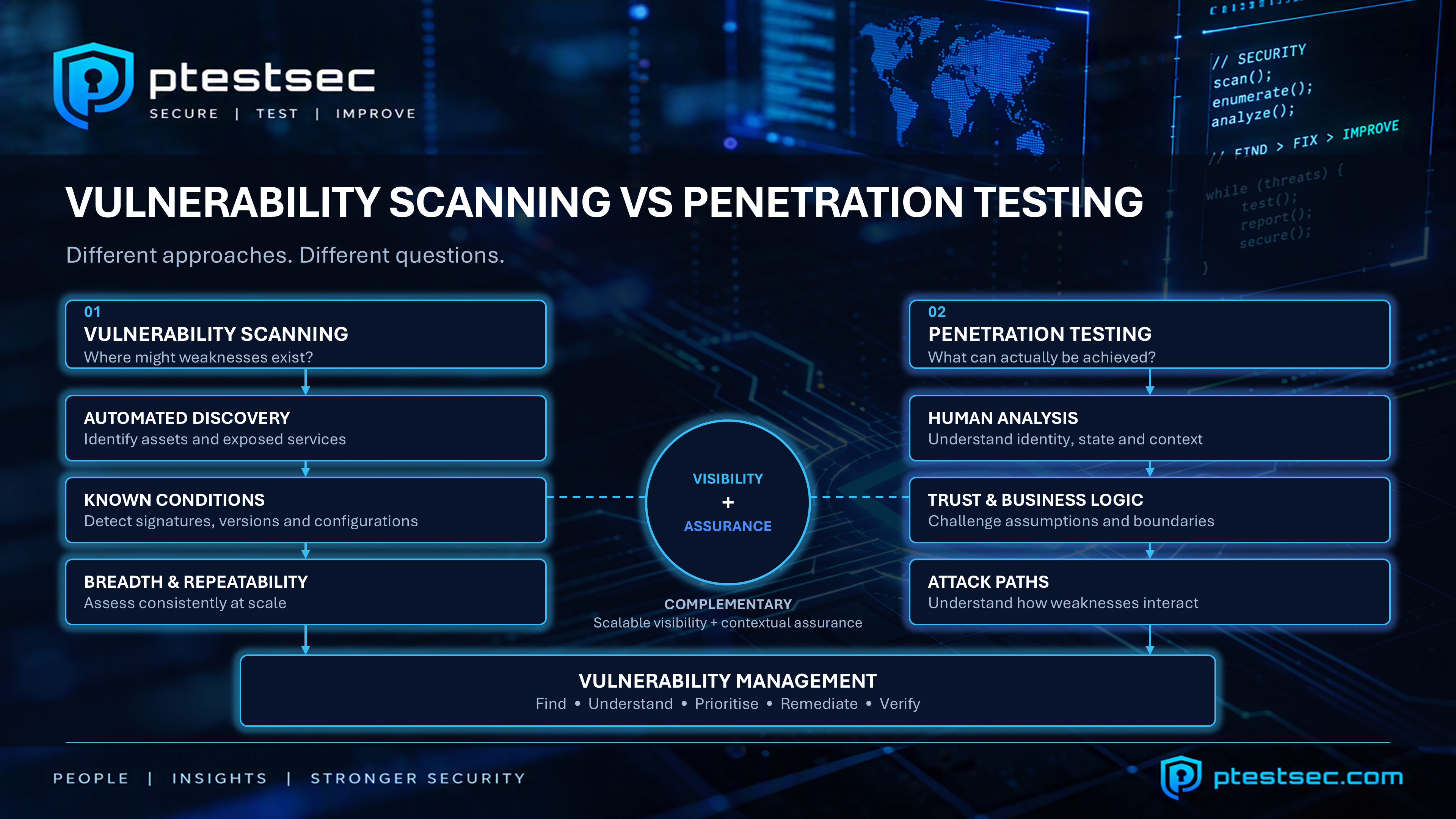
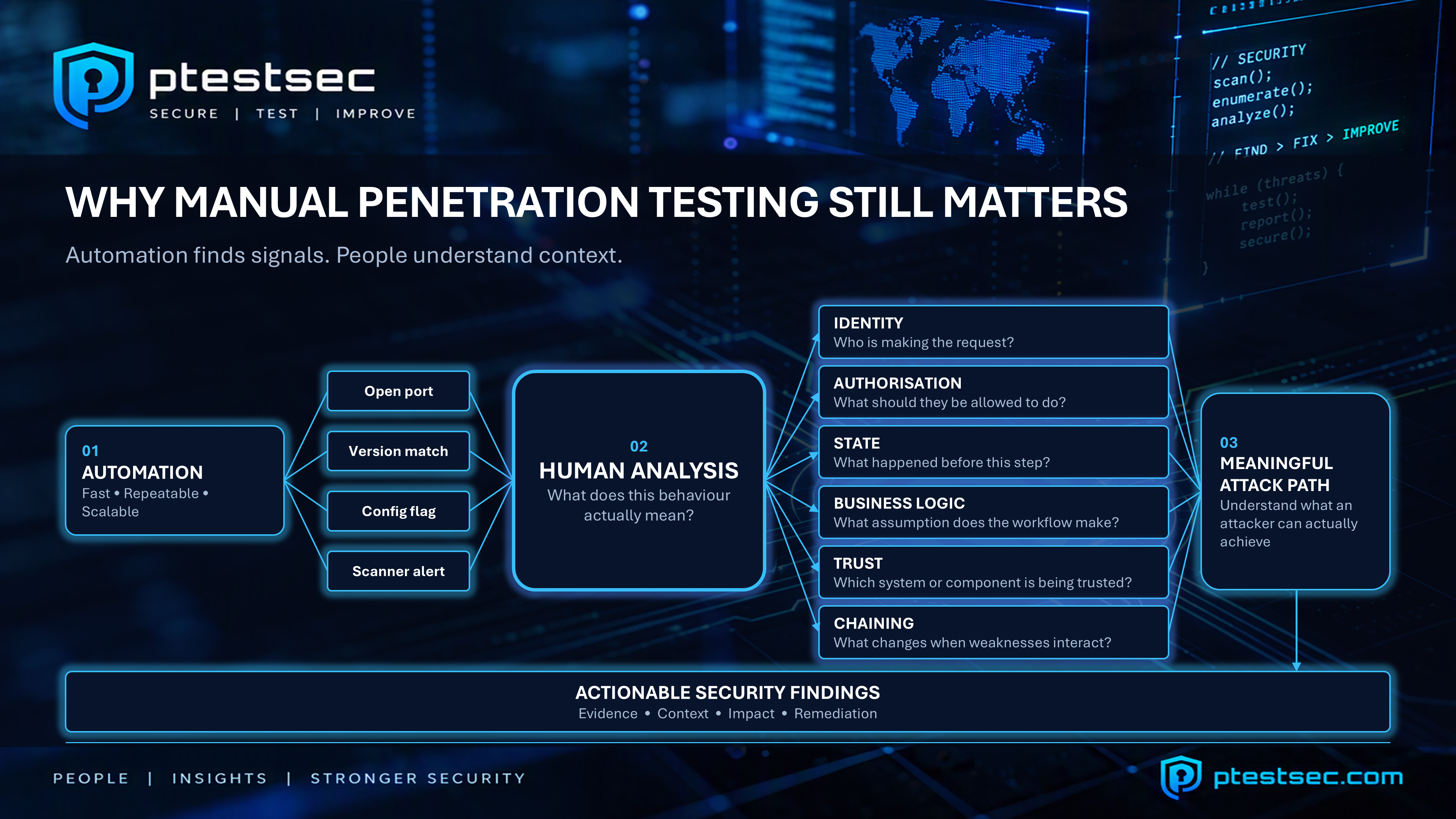
Security automation excels at repeatable detection across large attack surfaces. Manual penetration testing adds the reasoning needed to examine trust, identity, workflow and context, especially where the interesting weakness is not a single signature but the way legitimate system behaviours combine.
Why Manual Penetration Testing Still Matters in an Automated World
Modern security testing depends on automation. Scanners can inventory exposed services, detect known vulnerabilities, identify missing controls and repeat large numbers of checks at a speed no human tester could realistically match. Security teams would be weaker without that capability.
The case for manual penetration testing is therefore not that humans should replace tools. It is that the most interesting security question is often not simply whether a response matches a known pattern, but what assumption the system is making and whether that assumption can be broken.
Human led testing becomes valuable where security depends on context: who is making a request, what happened earlier in a workflow, which tenant owns an object, how two services trust one another, what a role is supposed to permit, or what an attacker could do after obtaining a modest foothold. These are areas where technical behaviour has to be interpreted against the intended security model.
Automation Is a Force Multiplier
A good penetration tester uses automation. Discovery, service enumeration, crawling, content analysis, parameter collection and targeted vulnerability checks can all benefit from tooling. Automation reduces repetitive work and creates more time for investigation.
The NCSC highlights the speed, scalability and cost effectiveness of vulnerability scanning, including the ability to run scans on a schedule or in response to deployment events. Those are exactly the properties organisations need for continuous vulnerability management.
Manual testing should build on that foundation rather than compete with it. If a tool can reliably enumerate hundreds of endpoints, there is little value in deliberately doing the same work slowly. The tester's time is better spent understanding why those endpoints exist, how identities interact with them and which paths create meaningful security boundaries.
Systems Are More Than Collections of Endpoints
Applications are designed around workflows, not lists of HTTP requests. A customer signs in, selects an object, changes a configuration, requests an action and perhaps waits for another user or service to approve it. Each individual request can be perfectly valid while the sequence as a whole creates a security problem.
OWASP's business logic testing guidance recognises this explicitly. It covers areas such as data validation within business logic, workflow circumvention, integrity checks, timing and restrictions on how many times a function can be used. These are not simply variations of input fuzzing. They require an understanding of what the application is meant to allow.
A tester asks questions such as: Can a later step be called before an earlier approval? Can a one time operation be replayed? Is a value trusted because the interface normally calculates it? Does the back end enforce the same state transition that the user interface suggests? What happens when two legitimate operations are performed concurrently?
That reasoning cannot always be derived from a generic signature because the expected behaviour depends on the application, its workflow and its security model.
Authentication Is Not Authorisation
One of the clearest examples is access control. A system can correctly authenticate a user on every request and still make a serious authorisation mistake.
OWASP distinguishes authentication from authorisation and recommends validating permissions on every request. In practice, that means a tester cannot stop at the fact that an endpoint requires a valid session. The interesting question is whether the authenticated identity is permitted to perform this specific action on this specific resource in this specific context.
Testing that properly often means using multiple accounts. If changing an object identifier while logged in as customer A returns customer B's data, the request has not bypassed authentication at all. It has demonstrated that the application authenticated the caller but failed to enforce ownership.
The same principle applies vertically. An ordinary user may discover an administrative endpoint that is hidden in the interface but insufficiently protected on the server. Automated tooling can sometimes identify exposed paths or suspicious behaviour, but determining whether a particular identity should be allowed to invoke an operation requires understanding the intended authorisation model.
The Weakness May Be Between Components
Modern systems distribute decisions across applications, APIs, identity providers, queues, cloud permissions and internal services. Each component can appear reasonable when viewed in isolation while the trust between them creates a path nobody intended.
An internal service might trust a request because it comes from another workload. A public application might be allowed to assume a cloud role that has accumulated excessive permissions. An API gateway might validate a token while a downstream service trusts an unvalidated header to decide which tenant owns the request.
Manual testing can follow those relationships. The tester is not limited to asking whether component A has a known vulnerability. They can ask what A is trusted to do with B, what B assumes A has already checked, and whether that hand off preserves the security boundary.
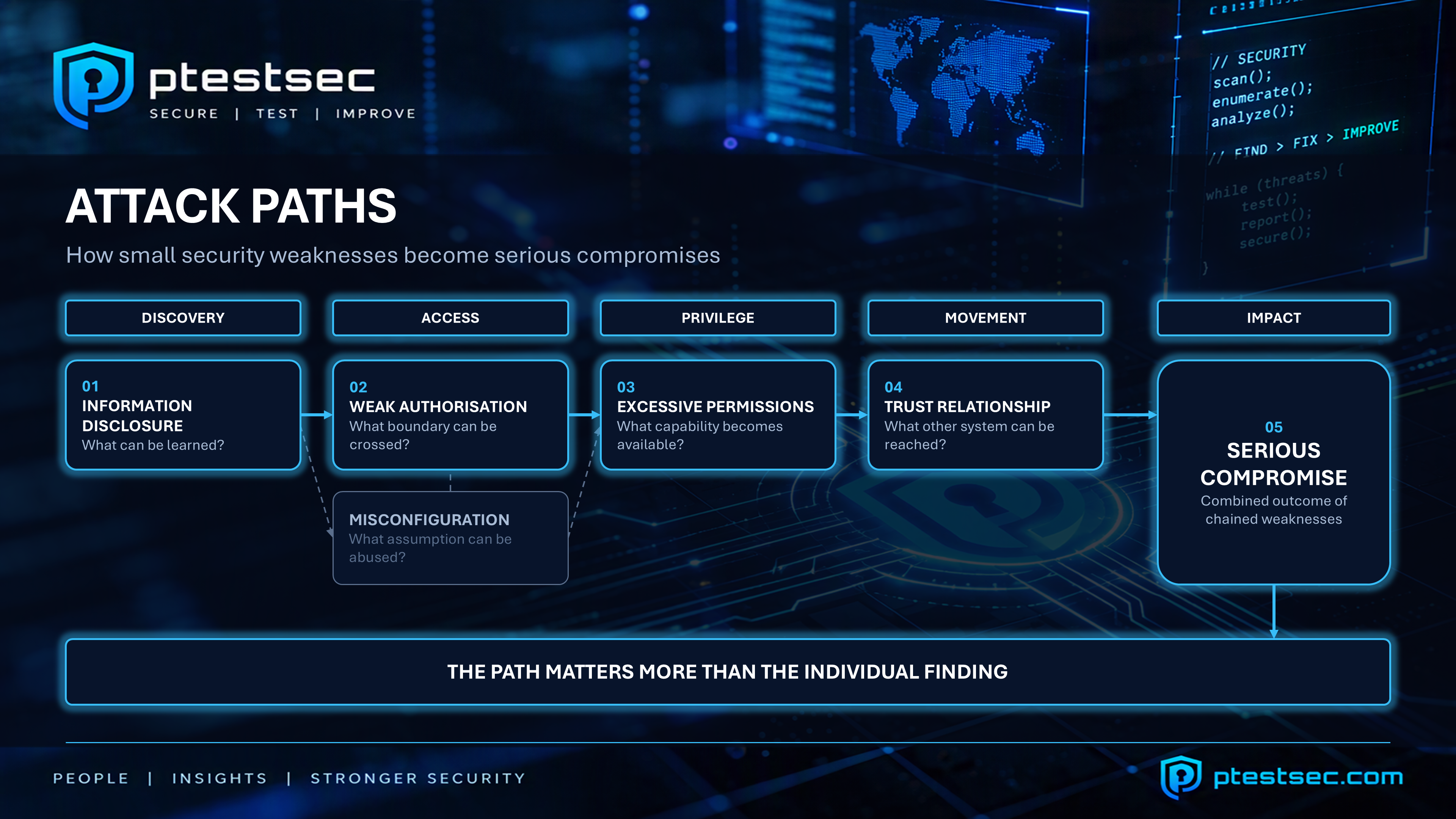
This is one reason attack path thinking is so useful. Real compromise can emerge from a sequence of modest decisions rather than one spectacular defect.
Context Changes the Meaning of a Finding
Two technically identical weaknesses can have very different consequences in different environments. An administrative interface reachable only from a tightly controlled management zone is not the same exposure as the same service available directly from the Internet. A credential with read only access to test data is different from an identity able to assume production roles. A reflected input issue on an isolated page is different from the same behaviour inside a privileged administrative workflow.
Standardised severity assessment is still useful because consistency matters. But the final assessment should explain the path, prerequisites and affected security boundary rather than relying only on a generic score.
This is where human testing and good reporting meet. The tester can validate whether the theoretical issue is reachable, identify the controls that constrain it, determine what legitimate access is required and explain which part of the architecture gives the weakness its importance.
Chaining Is a Reasoning Problem
Individual findings are usually reported separately because they need separate owners and remediations. Attackers are not required to respect those boundaries.
A low impact information disclosure may reveal a naming convention. A permissive endpoint may expose identifiers. A weak authorisation check may permit access to objects for known identifiers. An overly trusted internal service may then turn that access into a broader privilege boundary crossing. None of the individual observations necessarily describes the final compromise by itself.
Manual testing allows the assessor to retain state across those findings and ask whether they compose. The key question becomes not merely "what severity is weakness A?" but "what new ability does A create, and what can that ability reach next?"
That does not mean every collection of minor issues should be inflated into a dramatic chain. The chain should be demonstrated, evidence based and bounded by the rules of engagement. But where the interactions are real, reporting them only as isolated severities can hide the risk that actually matters.
Human Testing Still Needs Discipline
Manual does not mean improvised. Skilled testing should be systematic, reproducible and grounded in evidence. Established resources such as the OWASP Web Security Testing Guide provide structured coverage for information gathering, configuration, identity, authentication, authorisation, session management, input validation, business logic and other test areas.
The human part is the ability to adapt that structure to the system. A checklist can prompt a tester to examine authorisation; the tester still has to understand the application's roles, resources, relationships and expected permissions. A scanner can identify an endpoint; the tester still has to determine what the endpoint means to the business process.
Strong engagements therefore combine repeatable methodology with investigative depth. Neither aim is served by simply clicking "scan" and accepting every result, nor by avoiding automation to make testing look more artisanal.
Where Manual Testing Adds the Most Value
Manual testing tends to add the most value where security depends on relationships rather than syntax. That may be the relationship between one identity and another tenant's data, an ordinary role and privileged functionality, one service and another service it trusts, or several individually modest weaknesses that together create a meaningful attack path.
These relationships are often expressed through multi tenant boundaries, administrative privilege, business workflows, unusual state transitions, cross service trust and environmental context. The tester's role is not simply to observe that a technical behaviour exists, but to determine what that behaviour means within the security model and what capability it gives to an attacker.
Human led testing also matters when validating remediation. A patch may stop the exact proof of concept while leaving an equivalent route open through another endpoint, workflow or role. Retesting should therefore verify that the intended security property has been restored rather than merely confirming that one payload no longer works.
Key Takeaways
Automation and manual penetration testing are complementary. Automation provides the scale and repeatability required for modern security operations; manual testing applies context and adversarial reasoning where the system's intended behaviour matters as much as the technical response.
The strongest use of a tester's time is not reproducing checks that automation already performs reliably. It is challenging assumptions, following trust relationships, testing authorisation and workflow state, and determining whether separate weaknesses create a larger attack path.
That is why human led testing remains relevant even as security tooling improves. Better automation should raise the starting point of the assessment, leaving people to spend more time on the parts of security that require understanding.
Sources and References
- NCSC - Vulnerability scanning tools and services
- NCSC - Penetration testing
- OWASP - Web Security Testing Guide v4.2
- OWASP - Authorization Cheat Sheet
- OWASP - Business Logic Security Cheat Sheet
Research Notes and Limitations
This article discusses the respective roles of automation and human led security testing at a general level. The appropriate balance depends on the technology, threat model, maturity of internal vulnerability management and the assurance objectives of a particular engagement.