In this article
Severity is an important input to vulnerability management, but it is not a complete remediation queue. This article explains how CVSS, exploitation evidence, EPSS, environmental context and attack path thinking answer different questions when deciding what to fix first.
CVSS Severity vs Remediation Priority
A critical vulnerability deserves attention, but the highest CVSS score in a queue is not automatically the first issue every organisation should remediate. Severity and priority overlap, but they are not the same question.
CVSS provides a standard way to communicate vulnerability characteristics and severity. The National Vulnerability Database is explicit that CVSS is a measure of severity rather than risk. In CVSS v4.0, FIRST defines Base metrics for intrinsic characteristics, Threat metrics for characteristics that change over time, Environmental metrics for characteristics specific to a user's environment, and Supplemental metrics that provide additional context without modifying the final score.
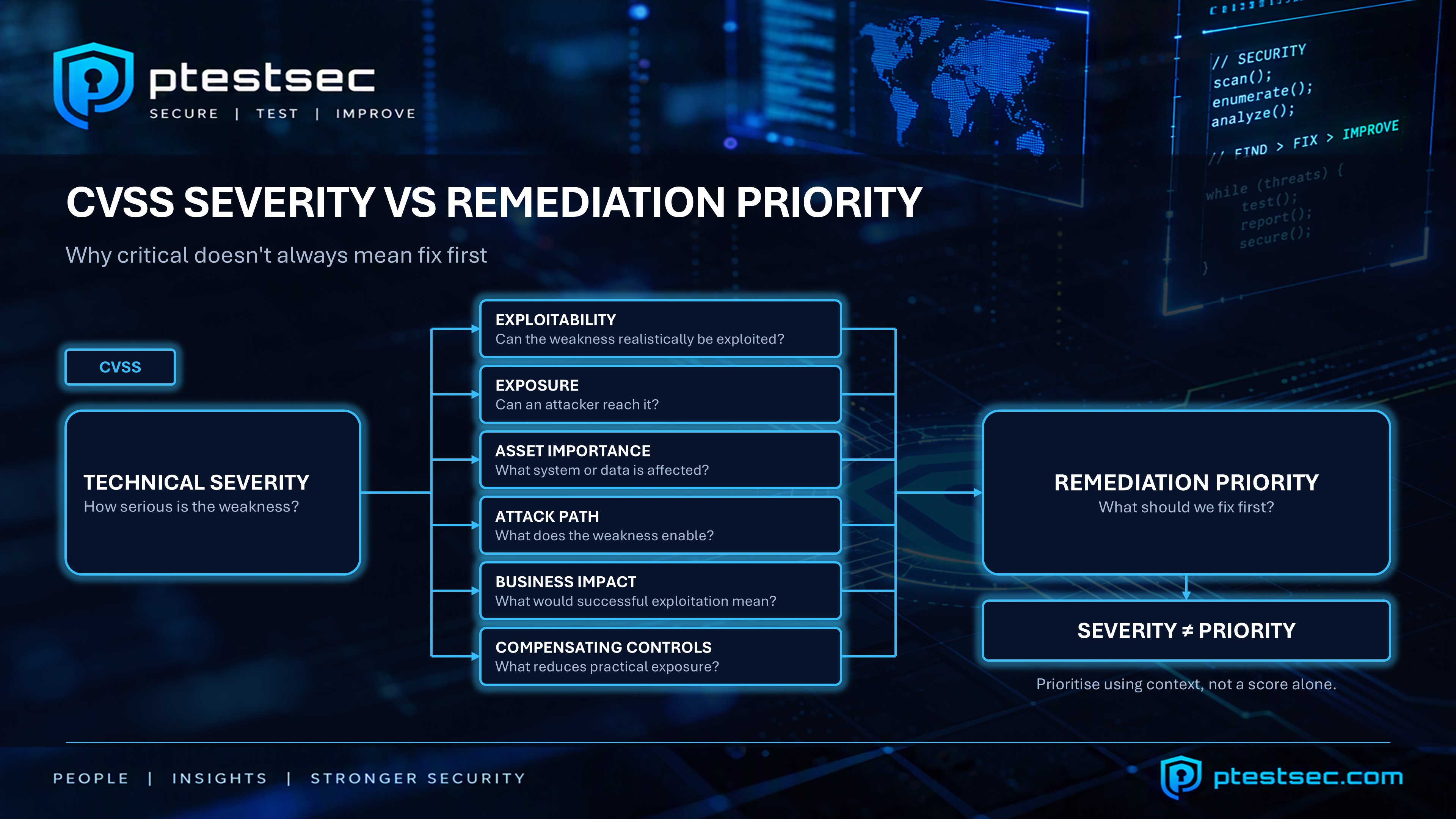
Those distinctions matter operationally. A security team deciding what to fix first also needs to know whether exploitation is occurring, how likely exploitation is to be observed, whether the vulnerable path is exposed in its own environment, what the affected asset protects, what controls constrain an attacker and what the weakness enables next.
What CVSS Is Good At
CVSS solves an important communication problem. Without a common framework, every vendor, scanner and internal team could describe vulnerability severity using incompatible language. A structured score and vector make the characteristics behind an assessment explicit.
The Base metrics are particularly useful as a stable description of the vulnerability itself. They capture properties such as attack vector, attack complexity, privileges required, user interaction and impacts. FIRST's specification then allows Threat and Environmental information to refine that picture.
This makes CVSS valuable for reporting, comparison and triage. The mistake is not using CVSS. The mistake is treating a Base score as though it already contains every fact required for an organisation specific remediation decision.
Severity Is Not the Same as Risk
NVD states the distinction plainly: CVSS is not a measure of risk. A Base score cannot know where your affected asset sits, whether the vulnerable feature is enabled, whether the relevant code path is reachable, what business process the system supports or which compensating controls are present.
Imagine the same technically critical vulnerability in two places. In one environment, the affected component is exposed to the Internet, handles sensitive data and runs with powerful credentials. In another, the vulnerable component is isolated, the affected feature is disabled and network controls prevent access from plausible attacker positions. The vulnerability can retain the same intrinsic Base characteristics while the organisational risk differs significantly.
That does not mean the second organisation can ignore it. Environmental conditions change, compensating controls fail and future attack paths may invalidate assumptions. It means the remediation decision should record the actual context rather than pretending the Base score already did that work.
Active Exploitation Changes the Conversation
CISA maintains the Known Exploited Vulnerabilities catalogue as an authoritative source of vulnerabilities known to have been exploited in the wild and recommends using KEV as an input to vulnerability management prioritisation.
That evidence answers a different question from technical severity: is there reliable evidence that the vulnerability has been exploited in the wild? A high severity issue with no observed exploitation and a lower severity issue that is actively exploited present different operational situations.
For organisations outside the specific mandates that apply to US federal agencies, KEV is still useful public threat intelligence. It should not replace local context, but confirmed exploitation is a strong reason to reassess exposure and accelerate remediation where the organisation is affected.
EPSS Adds Exploitation Probability
FIRST's Exploit Prediction Scoring System estimates the probability that exploitation activity for a published CVE will be observed in the wild within the next 30 days. The score is updated daily and ranges from 0 to 1.
FIRST is equally clear about what EPSS is not. It is not a complete risk score. It does not measure the damage successful exploitation would cause and does not know whether a specific organisation is exposed or protected by compensating controls. A complete decision still needs environmental context and probable impact.
That makes EPSS complementary to CVSS rather than a replacement. CVSS communicates severity characteristics; EPSS provides a probability signal about exploitation activity. CISA KEV provides evidence of known exploitation. Your own environment supplies the exposure, asset importance and controls.
Environmental Context Is Where Priority Becomes Local
Remediation priority becomes meaningful when generic vulnerability information is connected to the organisation's actual systems.
Is the asset Internet facing? Is authentication required before the vulnerable function is reachable? Does the affected service process regulated or commercially sensitive data? Can the system reach other trusted environments? Does the vulnerable process hold credentials that would make a successful exploit more valuable? Is the component isolated behind a control that is independently monitored and tested?
These questions are not excuses to downgrade inconvenient work. They are the information needed to distinguish theoretical severity from operational priority.
CVSS v4.0 itself recognises environmental context through its Environmental metric group. The practical lesson is that organisations should not stop at the published Base score when richer context is available.
Attack Paths Can Reverse the Queue
A medium severity weakness can deserve rapid remediation if it completes a credible attack path to a high value asset. Conversely, a critical vulnerability can be relatively less urgent if the affected component is demonstrably unreachable and multiple independent controls prevent the preconditions for exploitation.
The phrase "relatively less urgent" matters. Prioritisation is not binary risk acceptance. It is deciding how to deploy finite remediation capacity while keeping assumptions visible and reviewable.
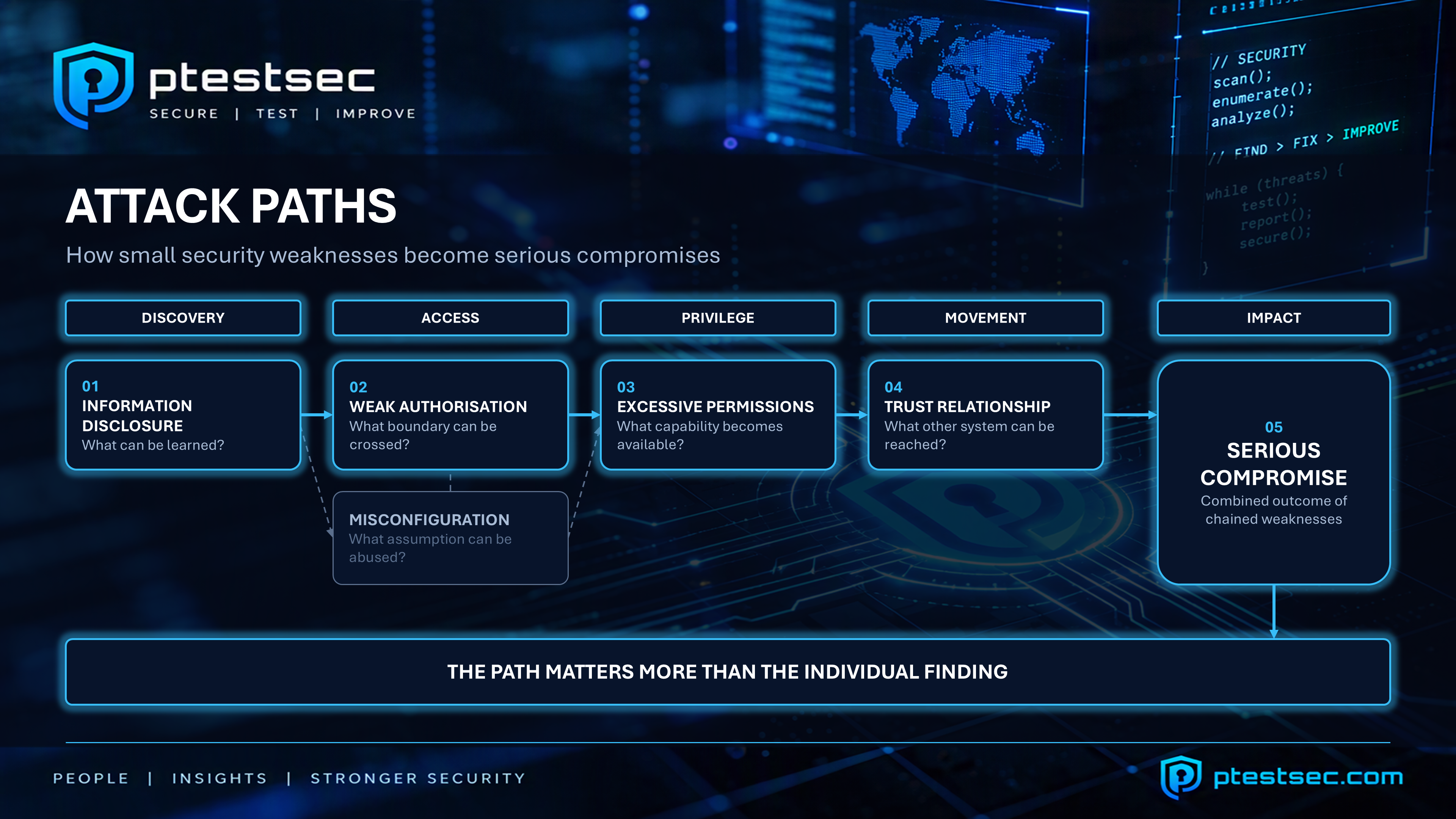
Attack path thinking is useful because it asks what capability a vulnerability provides. Does it reveal identifiers needed for another weakness? Does it create authenticated access? Does it permit lateral movement? Does it expose a token or service identity? Does it cross a tenant or privilege boundary?
The answer can change the remediation order even when the individual CVSS scores do not.
A Practical Decision Model
A defensible remediation decision can consider several distinct signals rather than collapsing everything into one number.
Start with the technical severity and the vector behind it. Check whether exploitation is known, using authoritative threat information such as CISA KEV where applicable. Use EPSS as a probability signal for published CVEs, making sure the probability is not misrepresented as organisational risk. Then add your own facts: exposure, affected functionality, asset criticality, privileges, segmentation, compensating controls and known attack paths.
CISA's Stakeholder-Specific Vulnerability Categorization is another example of a decision oriented approach. CISA describes SSVC as a methodology that helps analysts make vulnerability response decisions consistent with organisational priorities, using evidence and stakeholder context rather than relying on severity alone.
The important outcome is not a prettier score. It is a documented decision that another security engineer can understand, challenge and revisit when any of the inputs change.
Why Context Must Be Reassessed
Priority is not permanent. A vulnerability may begin with little exploitation evidence and later appear in KEV. EPSS can change as its model observes new signals. An internal service can become externally reachable after an architecture change. A compensating control can be removed. A previously low value system can inherit sensitive data or more powerful credentials.
Risk based prioritisation therefore needs feedback. Vulnerabilities deferred because of environmental conditions should be reassessed when those conditions change. The assumptions supporting a lower priority should be written down so teams know what would invalidate them.
This is one of the advantages of keeping severity and priority conceptually separate. The vulnerability's intrinsic technical characteristics can remain stable while the threat and environment around it evolve.
What a Penetration Test Contributes
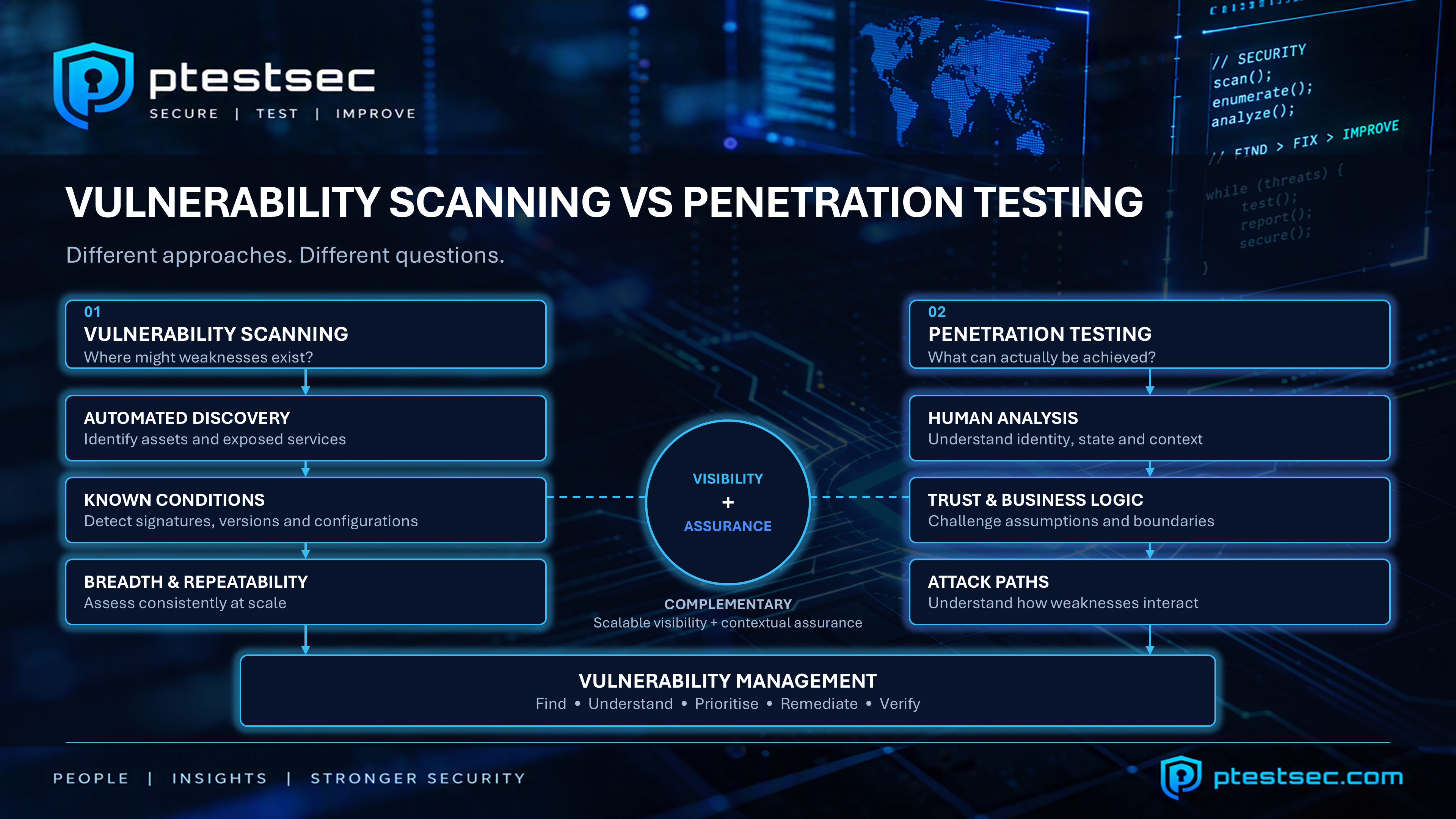
A penetration test can provide evidence that vulnerability feeds and scoring systems do not have: whether a weakness is reachable through the tested architecture, whether a control prevents exploitation, whether separate weaknesses connect and what security boundary is actually crossed.
That evidence should feed remediation rather than sit in a report as an isolated severity label. A tester who demonstrates that a medium finding creates a path from an ordinary user to privileged functionality has supplied context that should influence the fix order. Equally, demonstrating that a suspected critical condition cannot be reached under the tested configuration can improve the organisation's understanding of exposure, while still leaving the underlying vulnerable component to be managed appropriately.
Key Takeaways
CVSS is a severity framework and remains a valuable standard for communicating vulnerability characteristics. It should be used for what it measures rather than stretched into an organisation specific risk score it was not designed to be.
Threat information adds another dimension. CISA KEV tells defenders which listed vulnerabilities have known exploitation evidence, while FIRST EPSS estimates the probability of exploitation activity for published CVEs over the next 30 days. Neither knows the full context of your environment.
Remediation priority emerges when those signals are combined with exposure, asset importance, compensating controls and attack paths. The strongest decision is not necessarily "fix the highest number first"; it is the one supported by evidence, explicit assumptions and a clear understanding of what the vulnerability enables in your environment.
Sources and References
- FIRST - CVSS v4.0 Specification
- NVD - Vulnerability Metrics and CVSS
- FIRST - EPSS FAQ
- CISA - Known Exploited Vulnerabilities Catalog
- CISA - Stakeholder-Specific Vulnerability Categorization
- NCSC - Penetration testing
Research Notes and Limitations
This article presents a general vulnerability prioritisation model rather than a prescribed SLA or mathematical risk formula. Organisations should define remediation decisions according to their own risk appetite, regulatory obligations, asset context and operational constraints. EPSS probabilities and KEV membership change over time and should be checked against their authoritative sources when decisions are made.