In this article
Vulnerability scanning gives organisations repeatable breadth across known weaknesses; penetration testing provides deeper assurance by examining whether controls can be bypassed and what weaknesses mean in context. The two approaches solve different problems and are strongest when used together.
Vulnerability Scanning vs Penetration Testing
Vulnerability scanning and penetration testing are often discussed as if one were simply a lighter version of the other. That framing misses the useful distinction. They are different security activities designed to answer different questions, and a mature security programme can benefit from both.
The National Cyber Security Centre describes vulnerability scanning as an automated process for detecting defects across areas such as patch management, hardening and the software development lifecycle. Its guidance highlights the advantages of automation, speed, scalability and repeatability. By contrast, NCSC defines penetration testing as a method of gaining assurance by attempting to breach some or all of a system's security using the tools and techniques an adversary might use.
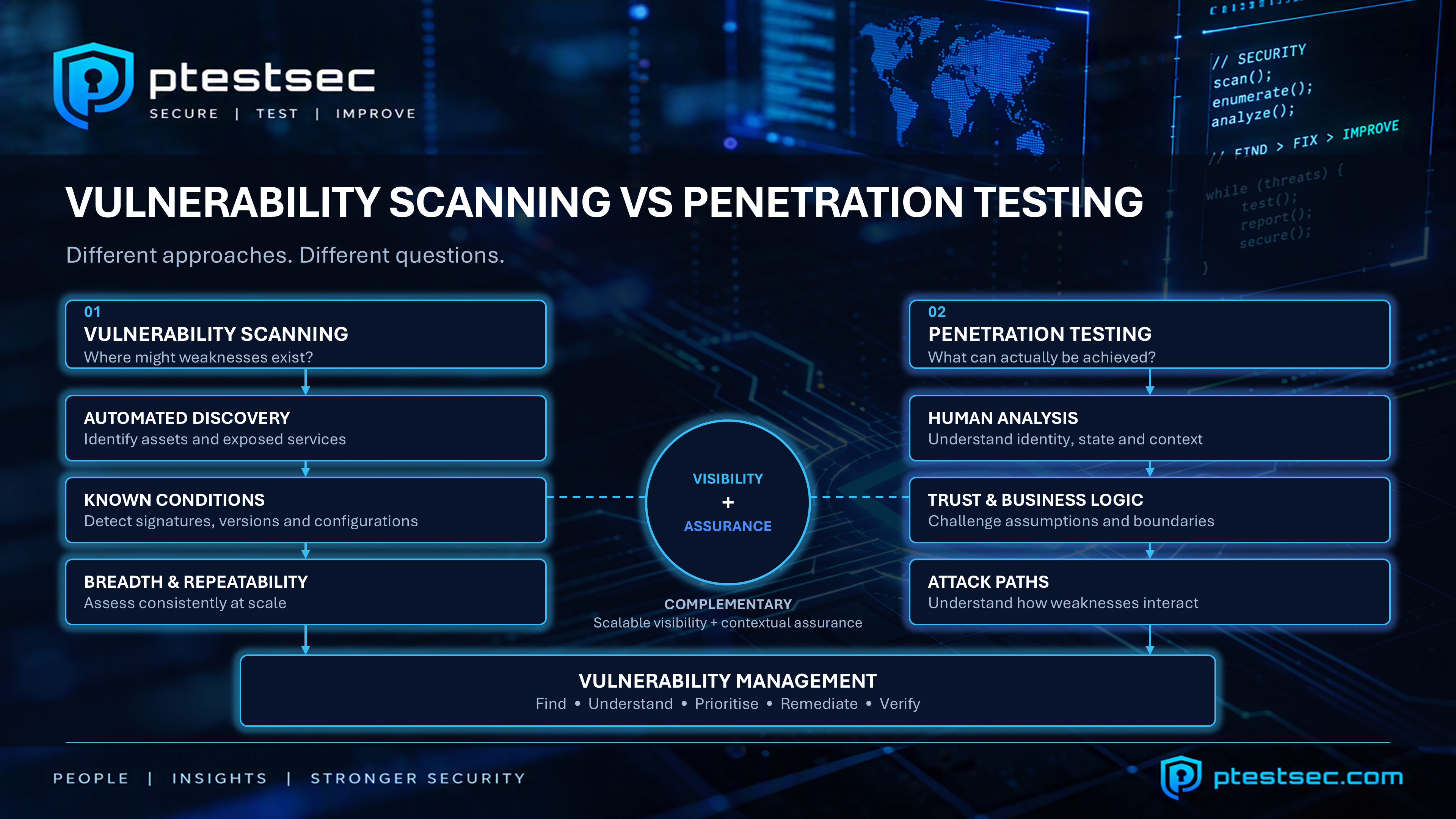
The practical difference is not simply "automated versus manual". It is the question being asked. A vulnerability scan is well suited to asking where known security weaknesses may exist across a broad estate. A penetration test asks whether an attacker can bypass the controls of a particular system, how weaknesses interact with its architecture and what a successful path could mean in context.
What Vulnerability Scanning Does Well
Automation is a strength, not a compromise. A scanner can apply large numbers of repeatable checks far faster than a person can perform them manually. That makes scanning suitable for regular use across servers, network services, applications and other assets where organisations need ongoing visibility into known vulnerabilities, missing patches or configuration weaknesses.
NCSC guidance specifically identifies automation, speed, cost effectiveness and scalability among the advantages of vulnerability scanning. Those characteristics make scanning a natural part of continuous vulnerability management. A scan can be scheduled, run on demand or triggered by events such as a new software build or server deployment, helping organisations maintain a more current view of their vulnerability landscape.
That breadth matters. Security teams need a systematic way to discover widespread hygiene problems and newly relevant weaknesses. Human led testing is too expensive and slow to replace continuous automated coverage across every asset. The right conclusion is not that scanners are shallow and therefore unimportant. It is that their value comes from repeatability and scale.
Where Scan Results Need Context
Depending on its capabilities and configuration, a scanner observes technical signals and applies detection logic that may identify a software version associated with a known vulnerability, a service that accepts a weak protocol, a missing security control or a configuration pattern that warrants investigation. Those observations are useful, but the resulting severity does not automatically describe the risk to the organisation.
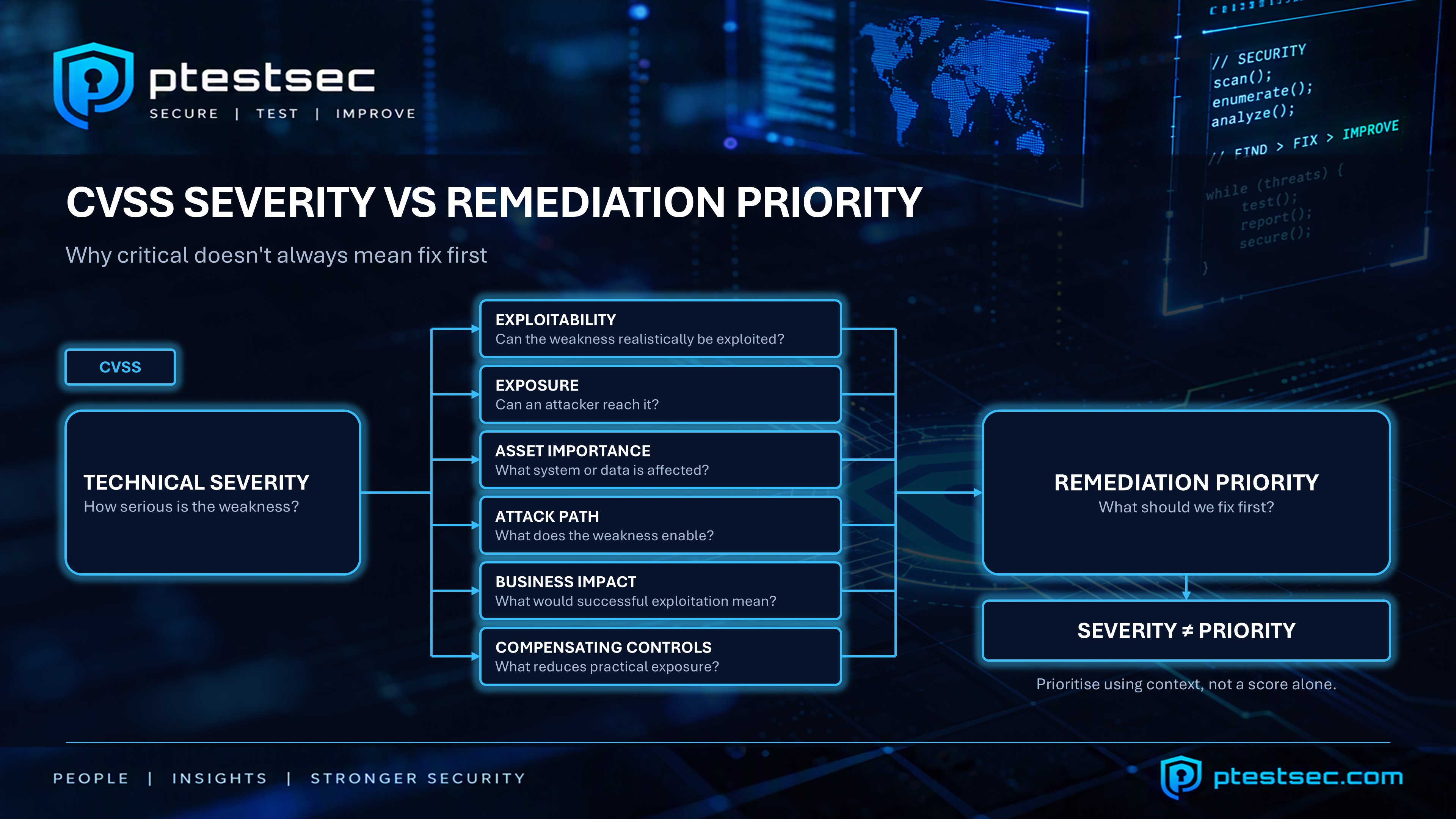
Some findings need validation. A detection may be a false positive, a vulnerable component may not be reachable through the expected path, or compensating controls may substantially change the exposure. Conversely, a simple automated finding can become more serious because of where the affected system sits, what identities it can reach or what data it protects.
The important step is triage. Scanning produces security information at scale; teams then have to decide what is real, what matters and what should happen next.
What Penetration Testing Adds
Penetration testing changes the focus from detection towards assurance. Instead of only asking whether a weakness appears to exist, the tester examines whether a relevant security objective can be defeated.
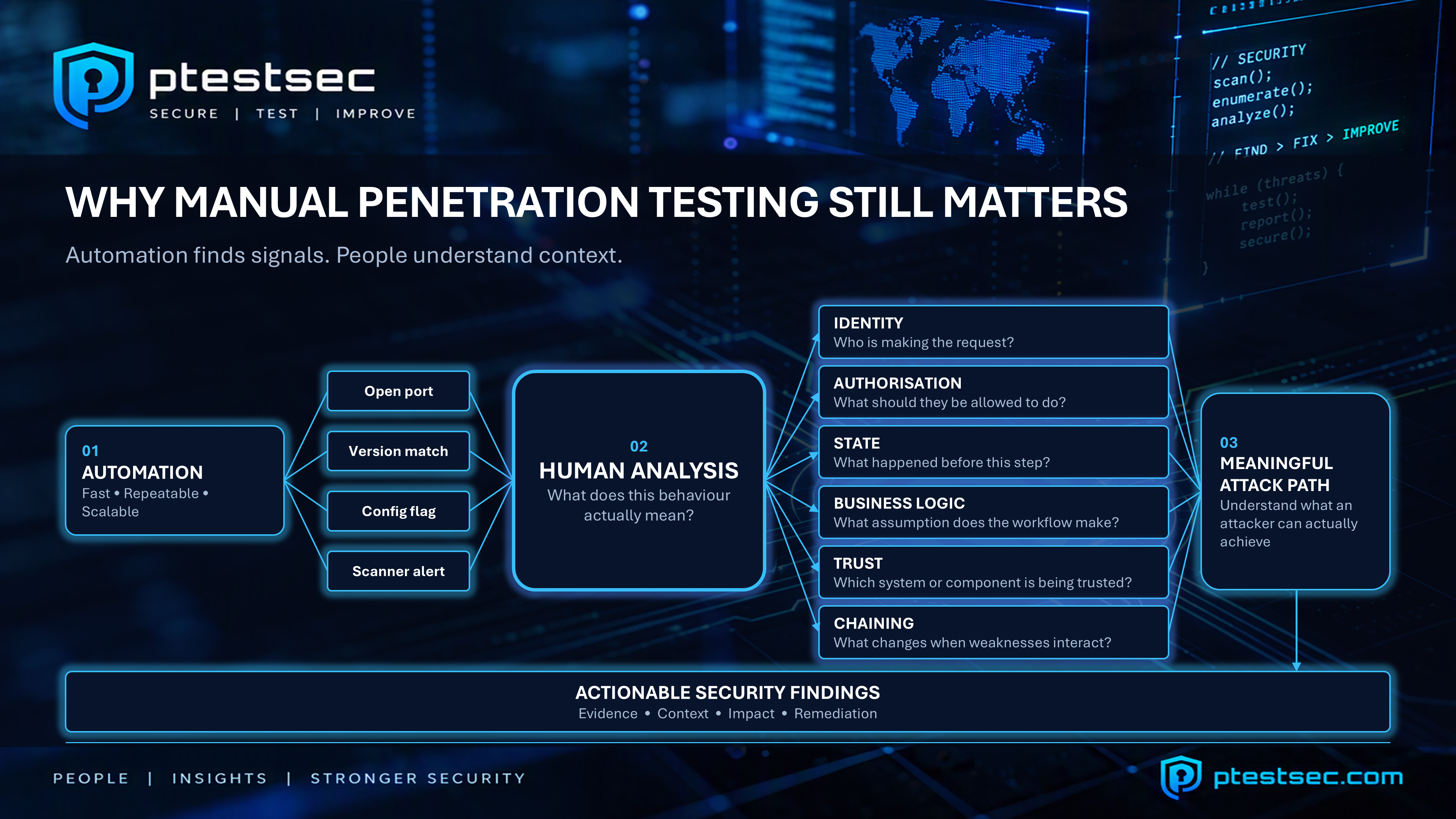
That may involve validating exploitation where it is safe and authorised, but exploitation is not the only difference. A tester can reason about identities, roles, trust relationships, application state and business workflows. For example, the individual requests in a customer management API may all be syntactically valid while one endpoint fails to re-check ownership when a record identifier changes. The interesting question is not whether the request matches a vulnerability signature; it is whether the system preserves the boundary between customer A and customer B.
OWASP's Web Security Testing Guide reflects this broader scope by treating areas such as identity, authentication, authorisation and business logic as distinct testing concerns. Business logic weaknesses often depend on understanding the intended workflow and the relationships between users, actions and state, which cannot always be inferred reliably from individual requests or responses.
Breadth and Depth Are Complementary
It is tempting to reduce the choice to breadth versus depth: scanning covers many systems, while penetration testing investigates fewer systems more deeply. That is directionally useful, but the activities also operate at different levels of abstraction.
A scanner might identify several technical conditions across a service. A tester can ask whether those conditions can be combined, whether they cross a trust boundary and whether the observable result matches the organisation's threat model. In the other direction, a penetration test is a point in time engagement and cannot provide the continuous estate wide visibility of a well run scanning programme.
UK Government Security guidance recommends using multiple methods rather than relying on a single process to discover vulnerabilities. That principle is more useful than arguing about which technique is "better". Broad automated coverage and focused adversarial assurance address different gaps.
Known Weaknesses Are Not the Entire Attack Surface
Many security issues have recognisable technical signatures. Missing patches, exposed services and common misconfigurations are areas where automation can be highly effective. Other weaknesses emerge from relationships between legitimate features.
Consider an application that correctly authenticates every request but fails to validate whether the authenticated user owns the requested object. Every request can look normal in isolation: valid session, valid endpoint, valid identifier. The weakness is contextual. Detecting it requires comparing what different identities are allowed to do and understanding the application's intended ownership model.
The same problem appears in multi step workflows. A process may validate every individual input while still allowing a user to skip an approval step, repeat a transaction, invoke a later state prematurely or reuse an operation that was intended to be one time. OWASP's business logic testing material addresses workflow circumvention, integrity checks, timing and limits on how functions can be used.
Penetration Testing Is Not a Replacement for Vulnerability Management
A pentest should not be the first time an organisation learns that widely known patches are missing across a large estate. NCSC guidance is explicit that penetration testing should be viewed as a method for gaining assurance in vulnerability assessment and management processes rather than the primary method for identifying vulnerabilities.
That is an important expectation to set. Skilled testers can discover subtle issues and demonstrate meaningful attack paths, but using expensive manual time to rediscover routine patching problems is rarely the best use of the engagement. Regular vulnerability discovery, inventory, patch management and secure configuration should continue between tests.
The penetration test can then challenge whether those processes and the system's deeper controls work as intended.
How the Two Fit Together
A practical security programme can use vulnerability scanning continuously or at a cadence appropriate to the environment. In practice, organisations may choose focused penetration testing around meaningful assurance points, such as important launches, significant architectural changes, external assurance requirements or specific risks that need independent examination.
Scan results can also inform a penetration test. Existing vulnerability information can help testers avoid spending time rediscovering what the organisation already knows and instead examine whether those weaknesses create a larger security problem. Conversely, findings from a pentest can improve scanning, hardening and engineering standards by showing where routine controls failed to detect or prevent an issue.
The relationship should be cyclical rather than competitive: discover broadly, investigate deeply, remediate, verify and feed lessons back into the security programme.
Choosing the Right Question
If the question is "which known weaknesses and configuration issues are appearing across our environment?", vulnerability scanning is the natural tool. If the question is "can a realistic attacker cross this security boundary or turn the behaviour of this system into unauthorised access?", penetration testing is better suited to the objective.
Sometimes both are needed for the same system. The distinction becomes much easier when the organisation begins with the decision it needs to make rather than the name of a security service.
Key Takeaways
Vulnerability scanning is valuable because it is automated, repeatable and scalable. It provides the breadth required for ongoing vulnerability management and should not be dismissed simply because human analysis is needed to interpret some results.
Penetration testing provides a different kind of evidence. It examines how controls behave in context, whether important boundaries can be crossed and whether individually modest weaknesses become meaningful when combined.
Neither activity replaces the other. Used together, scanning helps maintain continuous visibility while penetration testing provides focused assurance that the security properties the organisation depends on actually hold under adversarial examination.
Sources and References
- NCSC - Vulnerability scanning tools and services
- NCSC - Penetration testing
- GOV.UK Service Manual - Vulnerability and penetration testing
- UK Government Security - Discovering vulnerabilities
- OWASP - Web Security Testing Guide v4.2
- OWASP - Business Logic Security Cheat Sheet
Research Notes and Limitations
The exact coverage of a scanning product or penetration test methodology depends on the target technology, configuration, credentials, scope and assessment objective. Neither activity provides a permanent guarantee of security; systems, software and threat conditions continue to change after an assessment.